Featured projects
The Yardtopia Initiative: Works in progress
See how real residents have made their dream outdoor spaces a reality.
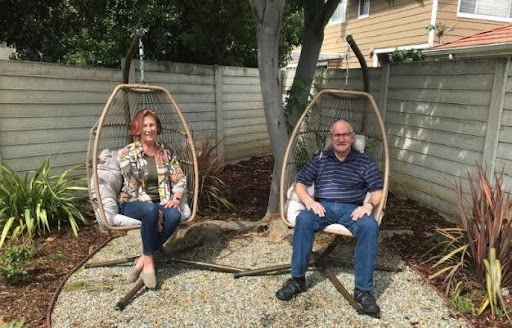
There’s a balance of emotions, living close to the nature of Santiago Canyon.
Since 1992, Gene and Connie Stannard have resided in Portola Hills on the edge of this brushy wilderness — enjoying visits from scrub jays, owls, eagles and woodpeckers, along with the occasional bat, rattlesnake, deer or mountain lion.
Fire has been an unwelcome visitor, ravaging the canyon in 2007, then again in 2017. In 2020, Gene and Connie watched as towering flames whipped and crackled through the brush behind their home, this time storming across the canyon from Whiting Ranch right up to their property line. When the couple later got word that their homeowners insurance was about to be cancelled, they rushed to fire-proof the house and firescape their yard.
They filled out an online application for a local turf rebate and removed 1,325 square feet of lawn using a sod cutter Gene rented from Home Depot.
The Stannards, who recently celebrated their 50th anniversary, are hard-core do-it-yourselfers, their labors of love frequently acknowledged by neighbors impressed with the heart they put into their transformation.
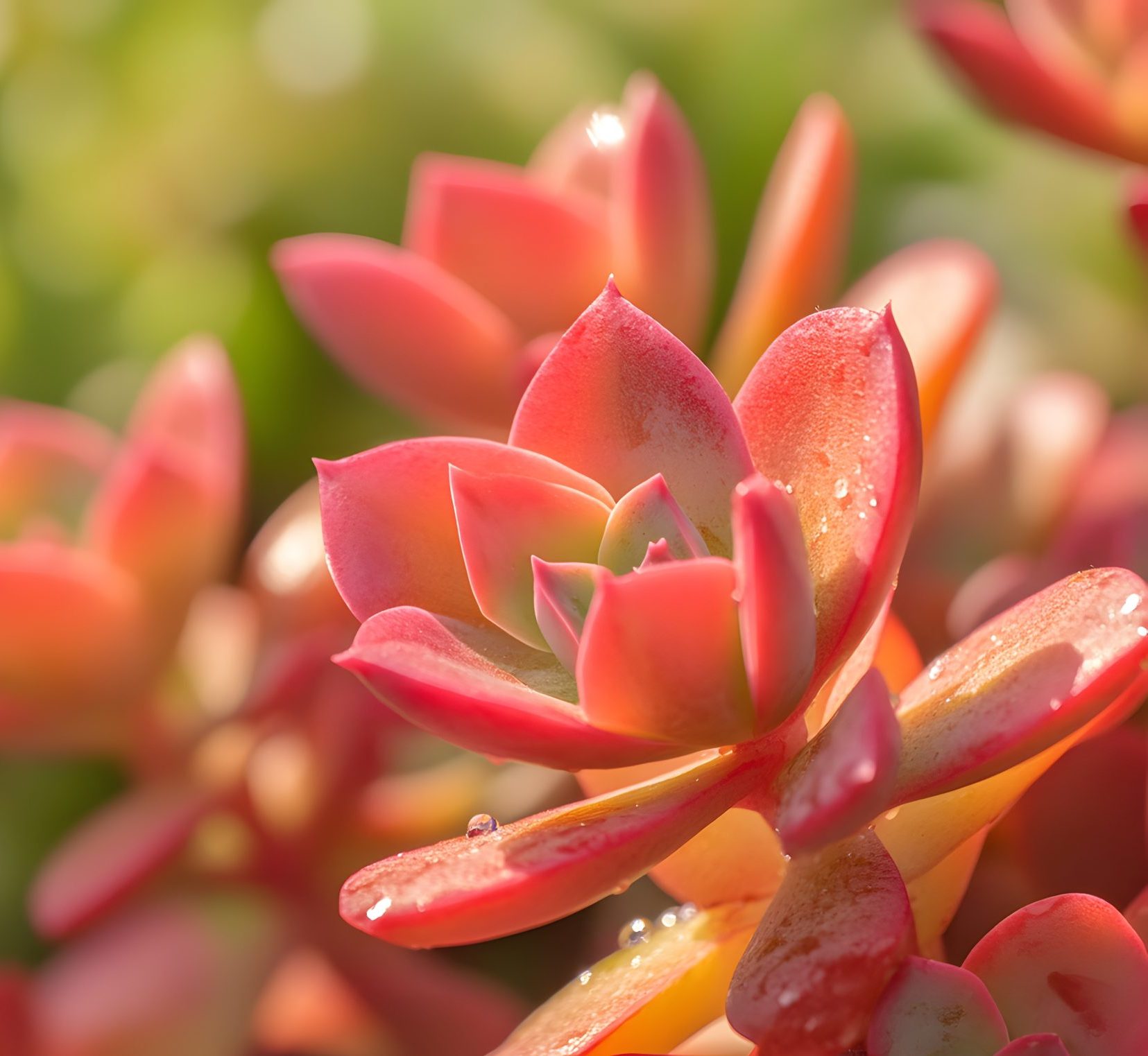
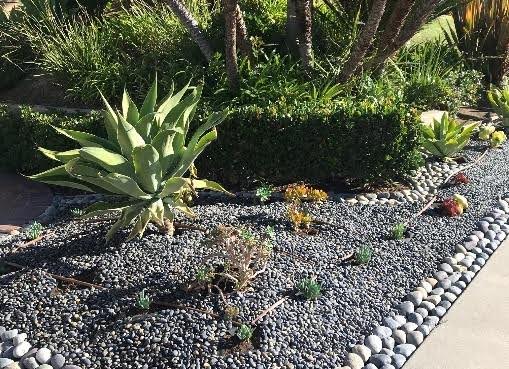
River rock of various sizes was used to create three dry creek beds on the property, comprising 12,000 pounds of stones large and small that the couple laid, one-by-one, by hand. Berms were built to form contours in the ground to capture rainfall and control irrigation runoff. A variety of succulents — many of which were propagated by Connie — were planted to add color to the landscape.
“We did everything except the drip irrigation,” said Connie.
Gene says he’s frequently asked if he’ll help neighbors with their yards.
“I always say no,” Gene said with a laugh, “but I’ll tell you how.”
His best advice: Be smart and don’t be afraid to ask questions.
After more than 35 years of parenting and grandparenting, the Hays’ home was best described as well-loved.
A wooden deck was rotting away. The lawn sat unused and uninviting, and a sitting wall — once a makeshift platform for the kids to parade on — created an impenetrable blockade that obstructed both function and design.
So, committed to making the most of their home in the years ahead, the Tustin couple made plans for a landscape renovation: reinventing their yard to create beautiful, livable spaces that make lounging out back their favorite place to be.
They were familiar with IRWD incentives to saving water, and applied for a turf rebate to get started.
Prequalification is important for turf removal, because it allows Irvine Ranch Water District to quantify the amount of lawn removed as a part of the project. (At $5 per square foot, this can lead to considerable savings.)
“The online application makes it really easy,” Linda Hay said. “You can track the progress of your application, and IRWD does a great job of keeping you in the loop and helping you along with way.”
The Hays worked with IRWD Water Efficiency Specialist Jake Loukeh, who made sure the application was on track and provided helpful resources as needed.
“We know the process can seem daunting at first, but we’re here to help people through it,” Loukeh said. “That includes a variety of planning resources for do-it-yourselfers.”
The Hays hired Linda’s rowing teammate, Amy Lawrence, to lay out the landscape design, hire contractors for the work and sum up all materials in one convenient invoice they could submit to cash in on rebates — about $4,000 worth, according to their estimates.
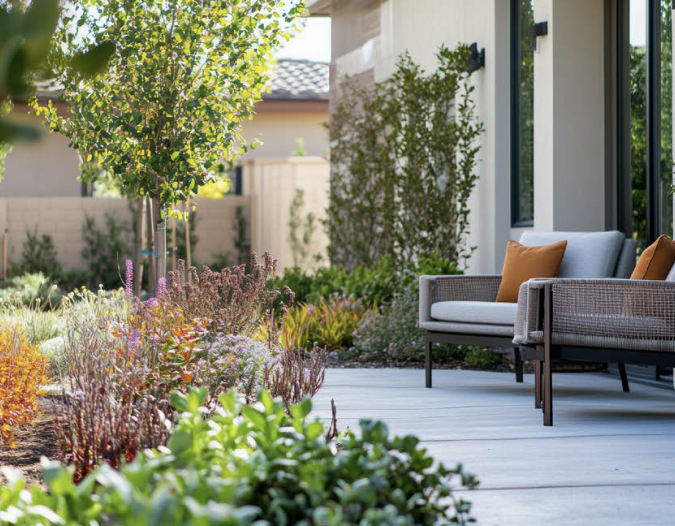
They used California native plants as the focal point of their new landscape: An elegant green-trunked palo verde tree produces a splash of showy yellow blossoms in spring. Several species of succulents provide subtle hints of blended hues and texture to the landscape, and flowering shrubs add a dimension of height with brilliant pops of color throughout the year. A row of vegetable beds, complete with rebate-approved water-efficient drip irrigation, provides healthy, hearty herbs and vegetables throughout the year.
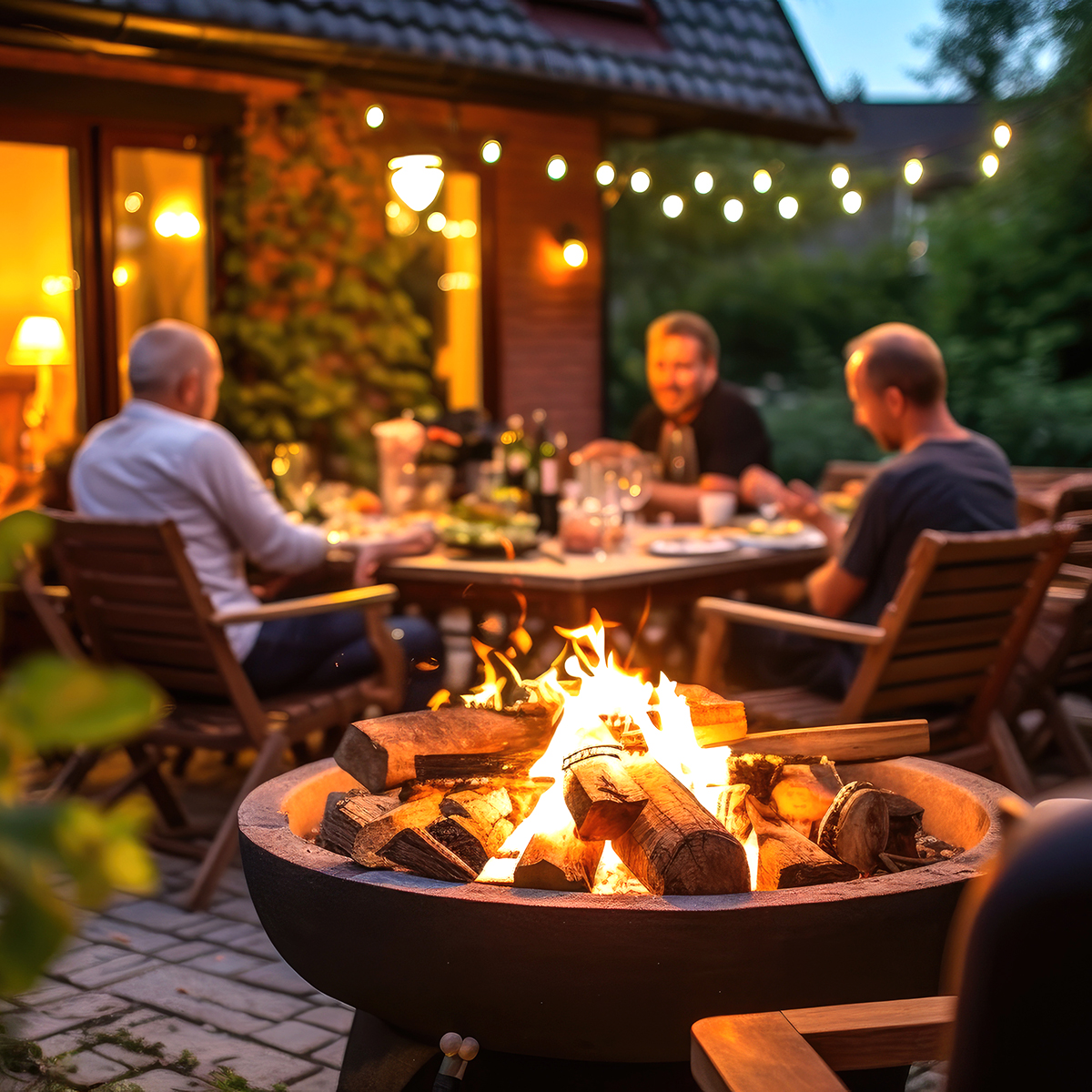
Hardscape features include a recirculating rock fountain that brings harmony to the landscape —doubling as a water source for birds and pollinators — and a fire pit to warm evening conversations with friends and family. Material from the demolition of the original patio slab and walkways was repurposed to fill permeable paths throughout the garden.
In the end, the new landscaping has reduced the couple’s water consumption and their monthly water bill.
“Best of all,” Scott Hay said, “our family and friends like to come over more often to enjoy our beautiful backyard.”

Maya Chen, 26, and Ethan Rodriguez, 28, turned their cookie-cutter Irvine starter home into the plant-filled entertaining space they’d been dreaming about since their apartment days.
When Maya Chen and Ethan Rodriguez bought their first home in Irvine’s Portola Springs in early 2024, they knew exactly what had to go: the builder-grade lawn that was “basically just boring grass eating up water and giving us nothing back,” as Maya puts it.
The couple, both software engineers who met at UC Irvine, had spent three years perfecting their container garden game in a tiny Costa Mesa apartment.
“We had this whole vision board on Pinterest of the garden we wanted someday,” explains Ethan. “When we finally got the house, that little lawn had to go immediately. It wasn’t us at all.”
The 850-square-foot backyard came with builder-standard turf, basic sprinklers, and zero personality. Maya and Ethan wanted to create an Instagram-worthy space where they could host friends for game nights and weekend BBQs, but their budget was tight after the home purchase.
“We’d been following plant influencers for years and knew exactly the vibe we wanted,” Maya says. “Something that looked expensive but was actually smart with money. We wanted plants that would grow with us and get more beautiful over time.”
Hardscape features include:
“The Yardtopia team totally got our vision,” Ethan explains. “They helped us choose plants that would photograph well but also thrive in our climate. We wanted that ‘plantfluencer’ look but with California natives that wouldn’t stress us out.”
The transformation took six weeks and reduced the couple’s water usage by 40%. But the real win? Their garden has become the hangout spot for their friend group.
“Every weekend, people want to come over,” Maya laughs. “We’ve hosted plant swap parties, outdoor movie nights, even a propagation workshop where we taught our friends how to take cuttings. The space just makes people want to gather.”
Maya says the best part is simpler: “I wake up every morning and actually look forward to checking on my plants. It’s like having this living art installation that changes every day.”
The couple’s advice for other young homeowners: “Start with what you know,” suggests Ethan. “We brought our container garden experience into the design. Don’t be afraid to ask questions and admit what you don’t know. That’s how you learn.”
Maya adds: “Budget for plants that will grow. We chose smaller sizes of plants we knew would get huge over time. Now, two years later, our agaves are already becoming statement pieces, and our fruit trees are starting to produce. It’s so much more satisfying than instant gratification.”
“This garden isn’t just pretty,” Maya reflects. “It’s taught us so much about patience, about working with nature instead of against it. And honestly, it’s the best investment we’ve made in our home. Every dollar we spend here makes us happier every single day.”
When Priya and Raj Patel moved into their Lake Forest home in 2019, they fell in love with the spacious backyard and its potential. But after three years of struggling with Southern California’s intense sun and unpredictable watering challenges, their once-promising outdoor space had become something they actively avoided.
“It was honestly embarrassing,” Priya admits, surveying what is now a lush, inviting landscape. “The soil was so compacted and dry that it looked like concrete. Our plants were either drowning or dying of thirst – there was no in-between. We’d spent thousands on beautiful native plants, but they kept struggling or dying despite our best efforts.”
The turning point came when their neighbor mentioned IRWD’s landscaping rebate programs and suggested they consider a water-wise transformation. But it was their landscape designer who introduced them to what Priya now calls “the magic ingredient” – a comprehensive mulching strategy.
“I thought mulch was just decorative wood chips you scattered around,” Raj laughs. “I had no idea it would completely transform how our entire yard functions.”
Working with their designer and an IRWD Water Efficiency Specialist, the Patels learned that their struggling plants weren’t just fighting the elements – they were fighting poor soil conditions that mulch could dramatically improve.
They applied for IRWD’s turf removal rebate, eliminating 800 square feet of water-hungry lawn that had become patchy and brown despite constant watering. But the real transformation began when they implemented a three-layer mulching system throughout their new native plant beds.
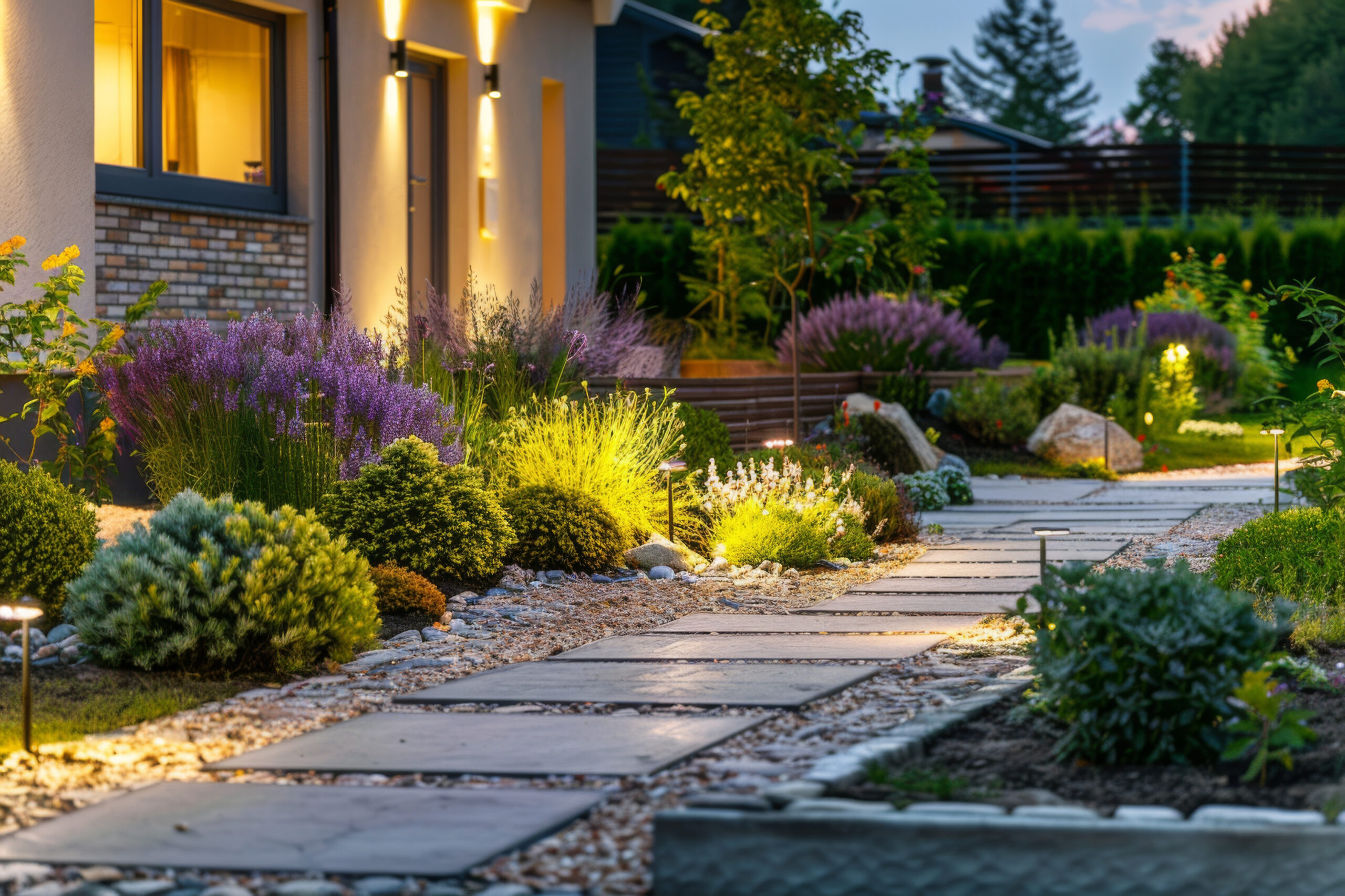
First came a base layer of compost-enriched mulch to improve soil structure and add nutrients. Then a middle layer of fine bark mulch for moisture retention. Finally, a top dressing of decorative stone mulch in carefully chosen areas to create visual interest while providing long-term weed suppression.
Two years after their mulch-focused transformation, the Patel family’s backyard has become exactly what they dreamed of when they first moved in – a beautiful, functional outdoor space where they genuinely love to spend time.
“Friends always comment on how lush and healthy everything looks,” Priya says with obvious pride. “But the best part isn’t how it looks – it’s how it feels to actually use this space. We went from avoiding our backyard to it being the heart of our home.”
The Patel family’s transformation included IRWD turf removal rebates and water-efficient irrigation upgrades. To learn more about available rebate programs and mulching strategies for your own yard transformation, visit IRWD’s website or speak with a Water Efficiency Specialist.


While others assume California gardens sleep through winter, Margaret Chen knows her Irvine backyard needs a different kind of attention during the cooler months. At 54, she’s mastered the art of winter plant care and discovered it’s more about restraint than effort.
“Winter is when my garden whispers instead of shouts,” Margaret says, surveying her thriving landscape on a December morning. “But it still needs me. Just differently.”
Margaret’s biggest winter adjustment? Cutting back on irrigation. Her drip system drops from twice-weekly summer waterings to just once a week, sometimes not at all if winter rains arrive.
“People kill more drought-tolerant plants with winter kindness than summer neglect,” she explains, testing soil moisture with her finger. If it’s damp two inches down, she skips watering entirely. When she does water, it’s always in the morning to prevent fungal issues on cold nights.
Her established California natives rely almost entirely on natural rainfall. “These plants evolved for wet winters and dry summers,” she notes. “I let nature do the work.”
Winter mornings find Margaret with pruning shears in hand. She shapes her lavender, removing about one-third of last year’s growth to prevent woody, leggy stems. Her rosemary hedge gets light trimming, and her Russian sage gets cut back to 6 inches.
“It looks severe now,” she admits, “but come April, it explodes with new growth and blooms.”
Most of Margaret’s plants get zero fertilizer in winter. Their growth naturally slows, and they don’t need extra nutrients. She makes exceptions only for winter bloomers like her society garlic, giving them light applications of organic, slow-release fertilizer in early November.
“Organic fertilizers are like a good meal,” she explains. “Chemical ones are just a quick jolt.”
Cool, damp conditions invite problems, so Margaret checks regularly. She watches lavender for signs of overwatering, removes powdery mildew from rosemary, and blasts aphids off new growth with the hose.
“Ladybugs usually arrive within a week to finish the job,” she notes, preferring natural solutions over chemicals.
Margaret finds winter care meditative rather than urgent. Her toyon berries glow red against gray skies. Ornamental grasses catch low-angle sunlight. On rare frosty mornings, her entire garden sparkles.
“There’s magic in every season if you know where to look,” she says, settling onto her bench with morning coffee.
“Winter taught me that good gardening isn’t about doing more. It’s about doing the right things at the right time. My plants don’t need constant fussing. They need me to understand their rhythms and work with the seasons. Some of my best gardening happens when I’m simply standing still, watching, and listening to what the garden is telling me.” — Margaret Chen.
As winter sunlight warms her garden, Margaret makes her final check, adjusting mulch here, testing soil moisture there. But mostly, she simply stands among her plants, grateful for the quiet beauty of California’s gentle winter.
Her garden doesn’t sleep. It rests, rebuilds, and prepares for spring’s explosion of growth. And Margaret? She does the same.
Looking for more winter garden care tips for your Southern California landscape? Visit Yardtopia.com for seasonal guides, plant care resources, and expert advice for water-wise gardening.