
Natural playground ideas are reshaping how families design their backyards, replacing plastic swing sets and rubber-matted equipment zones with landscapes built for exploration, imagination, and the kind of open-ended play that children actually crave.
KEY TAKEAWAYS
- A natural playground uses landscape features like boulders, logs, sand, water, and native plants instead of manufactured equipment, and it can work in any size Southern California backyard.
- Nature play supports sensory development, creativity, and physical confidence in ways traditional playgrounds often miss.
- Many natural playground elements are surprisingly affordable (or free), especially when you combine DIY projects with IRWD landscape rebates.
In Southern California, with 280 days of sunshine and an extraordinary palette of native plants, your backyard is already the foundation. It just needs a little intention.
This guide walks you through everything you need to design a nature play space at home: what a natural playground actually is, what research says about why it matters, the elements that work in any yard size, how to decide what to buy versus build, five weekend DIY projects you can start this Saturday, a California-native plant guide no other resource offers, and the safety basics that give you peace of mind while your kids explore freely.
What Is a Natural Playground? (And Why Your Backyard Is the Perfect One)
Natural playgrounds exist on a spectrum. On one end, you have fully natural spaces with no manufactured elements at all: just landscape features, plants, water, and loose materials. On the other end, hybrid designs blend natural materials with select pieces of equipment (a wooden climbing frame, a rope bridge) that are built from natural-style materials and integrated into the landscape rather than plopped on top of it. Most backyard natural playground ideas fall somewhere in between, and there are many approaches to a natural playground that works best in your Yardtopia.
The good news for IRWD customers: many of the elements that make a natural playground thrive also qualify for rebates.
Replacing thirsty turf with drought-tolerant groundcover and play zones can earn you $2 per square foot through IRWD's Turf Replacement Rebate Program.
If your design includes a water feature or mud kitchen fed by captured rainwater, rain barrels are rebated at $35 each (up to two per home), and rain cisterns at $250-$350 depending on size
For any planted areas within the space, IRWD's Mulch Madness Program offers up to 50% off mulch which is a natural playground staple for soft landings, sensory play, and moisture retention.
And if you're upgrading irrigation to keep living elements like native grasses and plants healthy, drip irrigation conversions are rebated at $0.50 per square foot, and smart sprinkler controllers at up to $200.
Creating a more playful yard and a more water-wise one can go hand in hand. You can build your Yardtopia that encourages outdoor play while making the most of the space you already have or thoughtfully expanding it.
PRO TIP
A natural playground does not need to replace your entire backyard. Start with one zone: a digging pit, a log balance beam, a sensory garden bed. Let it grow organically as your family discovers what draws your kids outside. The best natural playgrounds evolve over years, shaped by the children who use them. Visit irwd.com
Natural Playground Elements for Every Yard Size
The beauty of a nature play space is that it scales to fit any backyard, from a compact patio-adjacent yard to a sprawling lot. The secret is choosing elements that match your space, your children's ages, and the kind of play they gravitate toward.
Climbing and Balancing
Few things captivate children like the challenge of getting from one place to another on something that wobbles, tilts, or sits higher than the ground. Climbing and balancing elements are the backbone of most natural playground structures.
Log balance beams work in any yard. A single log laid horizontally, partially buried for stability, gives toddlers a low-risk balancing challenge and older kids a runway for imaginative play. Vary the diameter for different difficulty levels.
Boulder clusters (three to five boulders of graduated height) create a scrambling zone that builds strength and spatial awareness. Kids instinctively gravitate toward climbing rocks, and in Southern California, local stone suppliers carry beautiful sandstone and granite that weathers beautifully.
Tree stump stepping stones turn a path into an adventure. Stagger the heights and spacing so the route changes as your children grow.
Fallen tree trunks (positioned horizontally) offer a natural climbing element that doubles as a boundary wall, a bench, or a balance challenge.
Digging and Building
There is a reason children dig. It is one of the most fundamental forms of constructive play, and it requires nothing more than loose material and space.
Sand pit or digging zone: Even a 4x4-foot bordered area filled with play sand gives kids hours of open-ended building, burying, and discovering. Bury "treasures" (shells, smooth stones, quartz pieces) for an archaeological dig that resets every time you rake the sand.
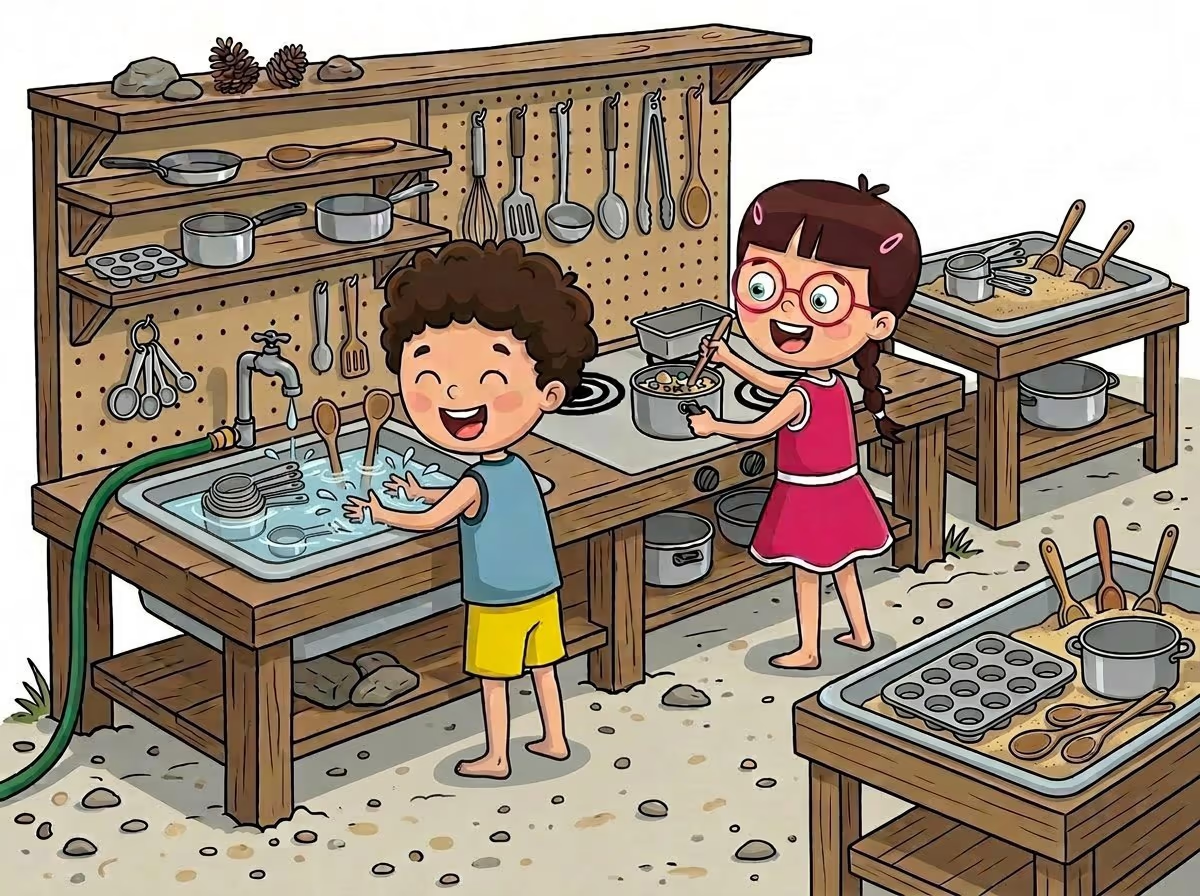
Mud kitchen: A dedicated space with old pots, wooden spoons, and access to water and dirt. See our dedicated How to Build a Mud Kitchen article for full plans.
Loose parts station: Sticks, pinecones, seed pods, shells, fabric scraps, and stones. Loose parts theory suggests that the most creative play happens with materials that can be moved, combined, and reimagined.
Water Play
Water is magnetic for children, and in Southern California, water-wise design means you can include it responsibly.
Rain chain water walls turn a downspout into a cascading sound sculpture children can redirect with cups and funnels.
Hand-pump water features with shallow stream beds teach cause-and-effect while keeping water contained and recirculating.
Dry creek beds channel rainwater naturally during winter storms and become imaginative river systems the rest of the year, perfect for sailing leaf boats and building pebble dams.
Water-wise splash zones using small recirculating pumps give the joy of water play without waste. The sound of water trickling over stones is enough to draw every child (and most adults) into the space.
Sensory Experiences
This is where a natural playground transcends "play area" and becomes something extraordinary. Sensory elements invite children to slow down, notice, and explore with their whole body.
Sensory garden beds planted with textured, fragrant, and colorful plants turn a garden border into a hands-on discovery zone. (See Section 6 for a complete California-native plant guide designed specifically for nature play.)
Sound gardens featuring bamboo chimes, hollow logs to drum on, and rain sticks made from dried plant stalks bring music into the landscape.
Barefoot paths with varied surfaces (smooth river stone, bark mulch, sand, soft grass, cool decomposed granite) invite children to notice what their feet are telling them.
Fragrance trails planted with Cleveland sage, rosemary, and creeping thyme release scent when brushed or stepped on, turning a simple garden path into an aromatic adventure.
Quiet Spaces
Not all play is loud. Some of the most meaningful time children spend outdoors is quiet, reflective, and solitary.
Living willow domes or teepees create green enclosures that feel secret and special, the kind of space children claim as their own.
Reading nooks under tree canopy or a shade sail, with a weather-resistant cushion and a basket of books.
Fairy gardens or miniature worlds built in a shallow planter give detail-oriented children a tiny universe to tend.
Hammocks or rope swings under a shade structure offer a place to rock, daydream, and watch the clouds.
| Element | Est. Cost | Yard Size |
|---|---|---|
| Log balance beam | Free to $50 | Any |
| Boulder cluster (3-5) | $200 to $600 | 100+ sq ft |
| Sand pit (4x6 ft) | $100 to $300 | Small |
| Mud kitchen (DIY) | $50 to $150 | Any |
| Sensory garden bed | $100 to $400 | 30+ sq ft |
| Living willow tunnel | $50 to $200 | Medium+ |
| Dry creek bed | $150 to $500 | Medium+ |
Natural Playground Equipment: What to Buy vs. What to Build
One of the most common questions about natural playground ideas is whether to buy manufactured equipment or build everything yourself. The honest answer: the best approach is almost always a combination.
When to Buy
Purchased natural playground equipment makes sense for anything involving height, heavy use, or structural engineering.
Manufactured natural-style equipment (wooden climbing frames, rope net structures, log swing sets) gives you the aesthetics of a natural playground with the safety engineering of commercial playground design.
Safety-certified equipment is worth the investment for any feature where your child climbs higher than two feet. Look for ASTM F1487 certification.
Typical cost ranges: Natural wood playground equipment runs $500 to $3,000 for individual structures, compared to $2,000 to $8,000 for traditional sets.
When to Build
DIY is the clear winner for ground-level elements, landscape features, and creative zones.
Low-height elements (under 24 inches) where fall injury risk is minimal: log balance beams, stepping stone trails, sand pits, garden beds.
Landscape features like boulder placement, dry creek beds, and mulch pathways that are really landscaping projects.
Creative elements like mud kitchens, fairy gardens, nature art stations, and loose parts collections.
Cost savings: DIY delivers 60 to 80% savings over purchased equivalents for most ground-level elements.
Natural Wood Playground Equipment: What to Look For
If you are purchasing natural playground structures, the wood species matters enormously in Southern California.
Best choices: Cedar, redwood, and black locust are all naturally rot-resistant, insect-deterring, and beautiful as they age.
Avoid: Pressure-treated lumber (CCA and ACQ chemicals are not ideal for surfaces children touch constantly) and painted surfaces that chip.
Bark removal: Stripped logs last longer and resist insect infestation better than bark-on versions.
Hardware: Use stainless steel fasteners if you live in coastal Southern California.
PRO TIP
For anything your child climbs higher than two feet, consider commercial-grade equipment with ASTM F1487 safety certification. For ground-level elements like balance beams, sand pits, and garden beds, DIY is not only cost-effective, it is often better because you can customize to your exact space, your children's exact interests, and your yard's exact dimensions.
DIY Natural Playground Ideas: Five Weekend Projects to Get You Started
Here is where the "Start Simple" framework pays off. You do not need to redesign your entire backyard to bring nature play home. You need one weekend, a few materials, and the willingness to let your kids get dirt under their fingernails. Each of these five DIY natural playground ideas can be completed in a single day, for less than most families spend on a Saturday dinner out.

Weekend Project 1: Log Balance Course
The experience: Your child steps onto the first log, arms out, and takes a tentative step. The bark is rough under bare feet. By the third log, the steps are confident. By next week, they are running the course.
Materials: Three to five logs of varying diameter (six to 18 inches), partially buried two to four inches for stability
Tools: Shovel, level, tamper
Time: Two to three hours
Cost: Free (sourced from tree trimming services) to $100
Tip: Vary the log diameters so the balance challenge changes with each step. Arrange them in a winding path, not a straight line, so kids practice turning while balancing.
Weekend Project 2: Sensory Digging Pit
The experience: Cool sand sifts through small fingers. A smooth stone emerges from the digging, then a quartz crystal, then a shell. Everything gets sorted into piles, rearranged, and buried again for the next explorer.
Materials: Landscape timbers or large rocks for the border, play sand, drainage gravel layer underneath
Dimensions: Minimum 4x4 feet, 12 to 18 inches deep
Include: Buried "treasures" (shells, smooth stones, safe fossil replicas) that rotate monthly
Time: Three to four hours
Cost: $100 to $200
Weekend Project 3: Nature Art Station
The experience: Mud mixed with flower petals becomes "paint." Leaves pressed into damp clay become prints. A fence-mounted chalkboard fills with drawings of the bugs found that morning.
Materials: Outdoor easel or fence-mounted chalkboard, natural paint supplies, collection baskets
Setup: Flat surface near a garden for easy material sourcing
Time: One to two hours
Cost: $30 to $75
Weekend Project 4: Stepping Stone Trail
The experience: Each stump is a different height. The gaps between them keep changing. Your child maps a route, tests it, adjusts, tries again. By the end of the afternoon, they have named every stump.
Materials: Tree stump rounds (12 to 18 inch diameter, four to eight inches tall), varying heights
Layout: Winding path through the yard with 12 to 18 inch gaps between stumps
Time: Two to three hours
Cost: Free to $150
Weekend Project 5: Living Willow Structure
The experience: By spring, the cuttings you planted have leafed out. By next year, the dome is green and enclosed. Your child has a living hideout that grows taller every season.
Materials: Fresh willow cuttings (available late winter through early spring in Southern California)
Structure options: Teepee, dome, tunnel, or fence
Note: Willow is water-loving. Place near an irrigation line or greywater runoff spot.
Time: Three to four hours to plant, one to two growing seasons to fill in
Cost: $50 to $200 for cuttings
GOOD TO KNOW
Look for free natural materials before buying anything. Tree trimming companies often give away logs and stump rounds. Local arborists may deliver wood chips for free. Neighbors clearing yards are happy to donate boulders and stones. NextDoor and Facebook Marketplace are excellent sources for materials in the Orange County area.
California-Native Plants for Nature Play Gardens
This is where your natural playground becomes something no other backyard guide can offer, and where resources on Yardtopia.com can help for inspiration. A natural playground is not just logs and sand. It is a living landscape. And in Southern California, the plants you choose transform a play area into a sensory wonderland that supports local wildlife, requires almost no water once established, and teaches children about the ecosystem they live in, simply by being beautiful enough to notice.
Why Native Plants Belong in a Natural Playground
Drought-tolerant once established means low maintenance and no guilt about water use. These are plants that evolved for exactly this climate.
Wildlife magnets. Native plants attract native wildlife: Monarch butterflies, Anna's hummingbirds, beneficial insects that become nature study subjects right outside your door.
Non-toxic varieties selected specifically for child safety. Every plant in this guide is safe for curious hands, noses, and (occasionally) mouths.
IRWD rebate eligible when replacing lawn. Your natural playground can qualify for IRWD landscape rebates when it replaces turf grass.
Sensory Plants for Play Gardens
Design your play garden so children discover something with every sense. Place these plants along pathways where little hands naturally reach, at the edges of digging zones, and bordering quiet spaces where noticing the details is part of the play.
Touch: Plants That Invite Small Hands
Lamb's ear (Stachys byzantina) has leaves so soft children will pet them like a rabbit's fur. Plant it at path edges where kids brush past.
California fuchsia (Epilobium canum) produces bright tubular flowers from late summer through fall that hummingbirds visit aggressively. The silvery foliage has a soft, almost velvety texture.
Smell: Plants That Release Fragrance When Touched
Cleveland sage (Salvia clevelandii) releases an intense, beautiful fragrance when even lightly brushed. The scent is strong enough to stop kids mid-run and make them ask, "What is that smell?"
Creeping thyme releases its herbal scent when stepped on, making it the perfect plant for between stepping stones and along barefoot paths.
See: Plants That Captivate Young Eyes
California poppy (Eschscholzia californica) is the state flower for good reason. Brilliant orange blooms open with the morning sun and close at dusk, giving children a daily lesson in plant behavior.
Seaside daisy (Erigeron glaucus) blooms in soft lavender and white across a long season, attracting butterflies that land close enough for a good look.
Taste: Plants That Reward the Brave
Strawberry tree (Arbutus unedo) produces bumpy red fruit that is safe, edible, and mildly sweet. The evergreen canopy provides year-round shade.
Pineapple guava (Feijoa sellowiana) has sweet fruit in fall and flower petals that taste like cotton candy. Yes, the petals.
Hear: Plants That Move and Whisper
Deer grass (Muhlenbergia rigens) rustles beautifully in the slightest breeze, and its tall seed heads become natural play materials (swords, wands, paintbrushes).
Purple needlegrass (Stipa pulchra), the California state grass, creates dramatic flowing movement that mesmerizes anyone watching. Planted in a group, it makes the wind visible.
Edible Landscape Borders
Surround your play zones with food-producing plants that teach children where food comes from and reward their curiosity with something delicious.
Dwarf citrus (Meyer lemon, key lime, mandarin) for small yards. The scent of citrus blossoms is reason enough.
Pomegranate thrives in Southern California heat and produces fruit that children find endlessly fascinating to open.
Fig trees grow quickly, tolerate drought, and produce fruit so sweet it barely makes it inside.
Herbs along every pathway: Rosemary, oregano, basil, and mint (kept contained, because mint has ambitions).
"The California Native Plant Society offers a searchable plant guide at calscape.org. Our local chapter, at chapters.cnps.org/oc, has several resources, too."
— Irina Ensminger, Board member, California Native Plant Society, OC Chapter
Butterfly and Hummingbird Attractors
These plants turn your natural playground into a living nature documentary.
Narrowleaf milkweed (Asclepias fascicularis) is the host plant for Monarch butterflies. Plant it and you may witness the entire lifecycle from caterpillar to chrysalis to butterfly.
Penstemon (multiple native species available) produces tubular flowers that hummingbirds cannot resist.
Monkey flower (Diplacus aurantiacus) blooms in bright orange and yellow, attracting both butterflies and hummingbirds.
Ceanothus (California lilac) erupts in stunning blue-purple blooms each spring, drawing bees and butterflies in numbers that make children gasp.
PRO TIP
Design your play garden so kids can touch, smell, and taste safely without supervision anxiety. Place sensory plants along pathways where little hands naturally reach. Keep thorny or irritating plants in raised beds or back borders. Every California-native plant in this list has been selected for child safety.
Safe Ground Surfaces for Natural Play Areas
Safety is the question every parent asks before building a natural playground, and it deserves a straightforward answer. The good news: creating a safe nature play space is simpler than most people expect, and the basics come down to one principle. The surface under any climbable element needs to absorb impact if a child falls.
The Consumer Product Safety Commission (CPSC) publishes clear guidelines: use 12 inches of loose-fill material under any equipment where children climb higher than the surface allows.
Here is how the most common natural surfaces compare:
| Surface | Fall Protection | Cost | Best For |
|---|---|---|---|
| Engineered wood fiber | Excellent (up to 12 ft) | $$ | Under climbing structures |
| Play sand | Good (up to 5 ft) | $ | Digging zones, low elements |
| Pea gravel | Good (up to 7 ft) | $$ | Pathways, low-height zones |
| Rubber mulch | Excellent (up to 12 ft) | $$$ | High-traffic areas |
| Decomposed granite | Low | $ | Pathways only |
| Native grass or clover | Low to moderate | $ | Open play, low elements |
A note for Southern California yards: Avoid dark-colored rubber mulch in areas that receive direct afternoon sun. Dark surfaces absorb heat and can become uncomfortably hot. Choose light-colored engineered wood fiber or play sand for zones in full sun.
Drainage matters here, too. Much of Orange County sits on clay soil that drains slowly. A proper installation places a drainage gravel layer beneath loose-fill surfacing to prevent waterlogging during winter rains.
GOOD TO KNOW
Concrete, packed earth, and standard landscape rock do NOT provide adequate fall protection. Any element a child climbs higher than 18 inches should have impact-absorbing surfacing underneath. The Consumer Product Safety Commission publishes free guidelines at cpsc.gov. When in doubt, more cushion is always the right call.

Frequently Asked Questions About Natural Playgrounds
What is a natural playground?
A natural playground is an outdoor play space designed with natural materials like logs, boulders, sand, water features, and living plants rather than manufactured plastic or metal equipment. The goal is open-ended, child-directed play that engages the senses and encourages creativity. They work beautifully in Southern California, where the climate supports year-round outdoor play.
How much does it cost to build a natural playground in your backyard?
A basic natural playground can cost as little as $200 to $500 using locally sourced materials. A more elaborate setup typically runs $1,500 to $5,000. Many elements can be built for free with reclaimed materials. Southern California homeowners may also qualify for IRWD landscape rebates when natural playground projects replace lawn with drought-tolerant plantings.
Is it cheaper to buy or build a playground?
Building natural playground elements is significantly less expensive than buying manufactured equipment. A DIY log balance course costs under $100, while a commercial natural-wood climbing structure starts around $500. The best approach for most families combines DIY ground-level elements with selectively purchased equipment for climbing features that require structural engineering.
What is the best ground surface for a natural playground?
Engineered wood fiber (EWF) is the most popular choice for under climbing structures because it provides excellent fall protection, looks natural, and costs less than rubber surfacing. In Southern California, choose light-colored surfaces to avoid heat buildup in direct sun.
What plants are safe for a children's play area?
California natives like Cleveland sage, California poppy, deer grass, and seaside daisy are safe, beautiful, and drought-tolerant. Edible plants like strawberry tree, pineapple guava, and dwarf citrus add taste exploration. Avoid oleander, castor bean, angel's trumpet, and any plant with thorns or irritating sap. All plants listed in this guide have been selected specifically for child safety and Southern California growing conditions.
How do I make a natural playground safe?
Follow CPSC guidelines: use impact-absorbing surfacing under any climbable element, ensure six-foot use zones around equipment, remove tripping hazards, and check for sharp edges on natural materials. Inspect logs and stumps for rot, insect damage, or splinters at the start of each season. Design sight lines so you can supervise from your patio or kitchen window without hovering.
What natural playground elements work in a small yard?
Even a 10x10-foot area can hold a meaningful natural play space. The best small-yard elements include a sand pit (4x4 feet minimum), a log balance beam, a stepping stone trail, a sensory planter bed, and a nature art station. Vertical elements like a fence-mounted chalkboard or climbing holds on a wall maximize play value without consuming floor space.
The Bottom Line
Nature play is backed by serious research. Children who play in natural settings develop stronger physical skills, sharper problem-solving abilities, and greater emotional resilience. Your backyard can be the place where that development happens every day.
Start with one weekend project. A log balance course, a digging pit, a sensory garden bed. The best natural playgrounds grow over time, shaped by the children who use them.
Southern California families have a unique advantage. Year-round outdoor play, an extraordinary palette of native plants, and IRWD rebate programs that can offset costs when you replace lawn with landscape-based play areas.
Ready to bring nature play home? Start with one project from the DIY section above, or explore our complete Kids Backyard Guide for more ideas. For design inspiration, try the SimplyScapes Design Tool to visualize how natural play elements fit into your yard.
Your backyard is already the foundation. It just needs a little imagination, a few logs, and the sound of your kids laughing outside.