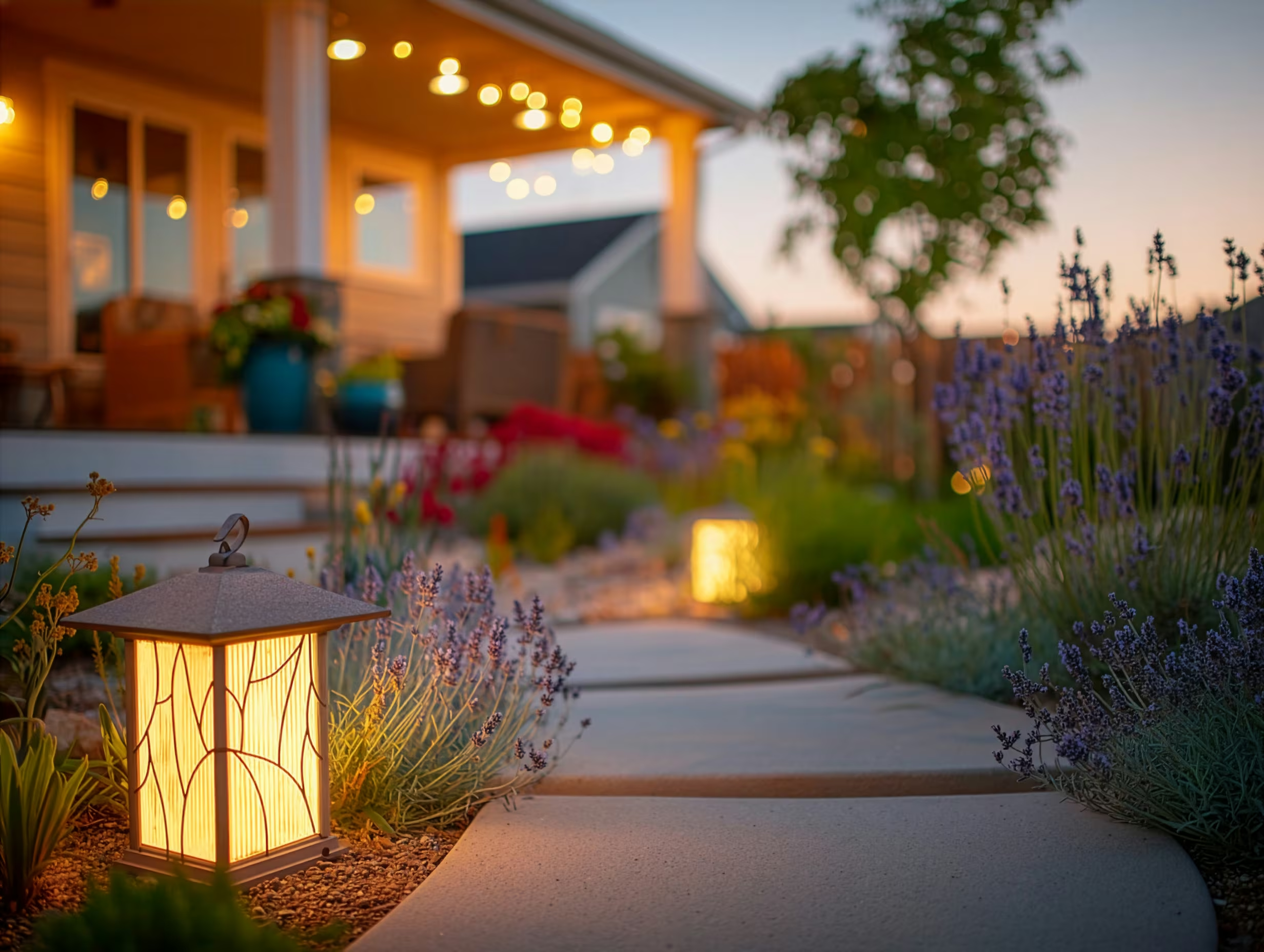
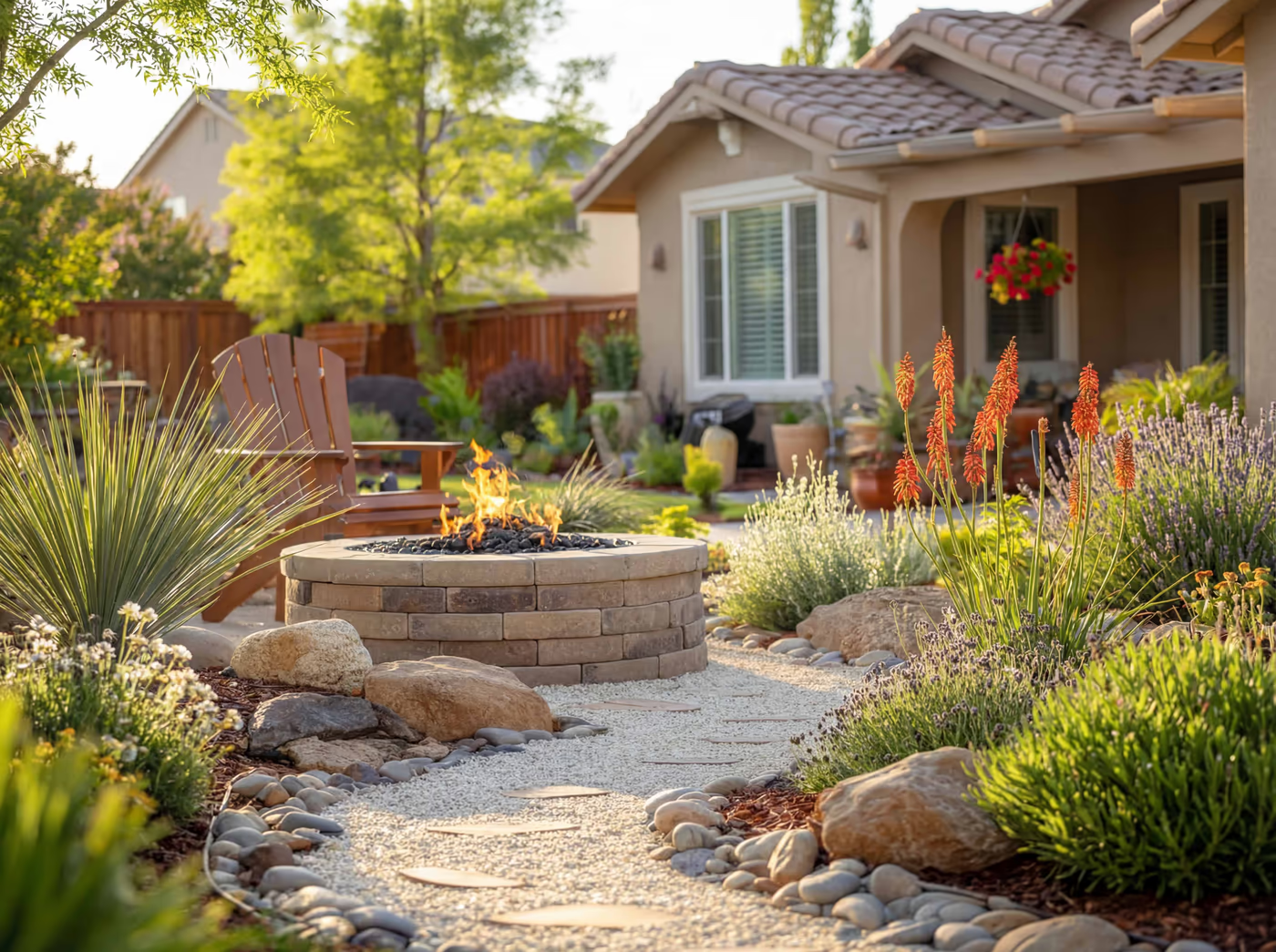
A well-laid Yardtopia path makes a sound underfoot: a soft, satisfying crunch, somewhere between beach sand and fresh snow. It’s the sound of an outdoor living space that has its details handled.
That’s exactly how decorative rock and gravel work in a landscape: quiet materials doing the practical work of clean edges, easy drainage, and low-upkeep zones, while your planting does the showing off.
KEY TAKEAWAYS
- Decorative rock and gravel work hardest as accents and edges: borders, buffer strips, paths, and drainage runs that frame lush planting rather than standing in for it
- A fence-line buffer strip of decomposed granite or gravel is the easiest high-impact starting point, cutting trimming chores while giving the yard a crisp, finished line
- Plan for low maintenance, not zero: an occasional weeding pass, a light rake, and a top-up every few years keeps rock and gravel looking freshly installed
If you have ever admired a neighbor’s yard and struggled to say exactly why it looks so finished, the answer is usually at the edges. A crisp band of gravel along the fence. A pale path that curves through the planting. A shallow run of river rock that carries winter rain away without anyone thinking about it.
This guide walks through the most useful materials in decorative gravel landscaping, where each one shines, and how to combine them with generous planting so your yard reads as lush and designed.
Whether you are after cleaner lines, better drainage, or a few reclaimed weekends, the right stone in the right place gets you there and the perfect options for your Yardtopia.
What can decorative rock and gravel actually do for a SoCal yard?
Decorative rock and gravel earn their place in a SoCal yard by doing three jobs exceptionally well: creating crisp edges, managing water, and filling low-traffic zones that need almost no upkeep. The beauty still comes from the planting. The stone is the frame that makes the planting look intentional.
The three jobs rock and gravel do best
1. Clean edges come first. A defined band of stone between a bed and a fence, a path and a border, or a patio and the planting gives the whole yard a tailored look, the outdoor equivalent of a fresh hem.
2. Drainage is the job most people underestimate. Gravel and river rock guide runoff where you want it, and their open texture lets rain soak into the ground instead of sheeting across it.
3. Low-upkeep fill rounds out the trio. Side yards, utility corners, and the shady strip where nothing wanted to grow all become tidy, finished spaces with a layer of gravel and a few well-placed plants. That is why stone shows up in nearly every plan for low-maintenance landscaping in SoCal: it quietly retires the chores you like least.
How to use rock as an accent, not a theme
Keep stone in a supporting role and let plants carry the scene. A yard covered fence-to-fence in rock reads as unfinished, while the same materials used as borders, paths, and pockets within layered Mediterranean planting read as designed. A good gut check: standing at the curb, you should notice the plants first and the stone second.
Angular, crushed stone locks together and stays put, which is why it suits paths and buffer strips. Rounded river rock stays loose and shifts underfoot, which is exactly what you want in a decorative dry creek bed but not on a walkway. Matching the shape of the stone to the job is half the design battle.
What are the main types of landscape rock and gravel (and where does each work best)?
The four most useful materials for SoCal yards are decomposed granite for paths and soft edges, river rock for drainage runs and accents, crushed or pea gravel for utility zones and fill, and boulders as focal points within planting. Each has a distinct look and a best-fit job for your Yardtopia.

Decomposed granite: paths and soft, natural edges
Decomposed granite, usually shortened to DG, is finely crushed stone in warm gold and tan tones that compacts into a firm, walkable surface. A decomposed granite path is the classic SoCal move: it suits Mediterranean and Spanish-style homes, feels barefoot-friendly by summer evening, and blurs beautifully into planted borders. Stabilized DG holds its shape longer near patios and seating areas, while loose DG gives garden paths that soft, natural finish.
River rock and cobble: dry creek beds and drainage runs
River rock is smooth, rounded stone in mixed grays, creams, and blues, typically 1 to 3 inches across, with larger cobble adding variety. It is the material of choice wherever water moves: a meandering dry creek bed, the splash zone under a roofline, or a gentle swale that steers runoff away from a patio. Its polished texture also makes a handsome accent band around container groupings and fountains.
Crushed gravel and pea gravel: utility zones and fill
Crushed gravel and pea gravel are the workhorses for the practical corners of a yard: side yards, bin and equipment zones, and the ground plane around raised planters. Pea gravel’s small, rounded pebbles feel pleasant underfoot and drain quickly, which is also why gravel is a favorite surface in dog runs and dedicated pet zones. Choose one color family and stick with it so utility areas feel like part of the design.
Boulders and feature stone: focal accents within planting
A few well-chosen boulders give a yard instant age and structure. Place them in odd-numbered groups, settle them so they look naturally seated rather than dropped, and let groundcovers and grasses lap up against their bases. One generous stone beside a path does more design work than a dozen small ones scattered around.
| Material | The look | Best for | Drainage behavior | Typical cost |
|---|---|---|---|---|
| Decomposed granite | Warm gold, fine texture, compacted | Paths, casual patios, soft edges | Permeable, sheds heavy rain when compacted | $1 to $3 per sq ft installed |
| River rock | Smooth, rounded, mixed cool tones | Dry creek beds, drainage runs, accents | Excellent flow-through | $3 to $8 per sq ft installed |
| Crushed or pea gravel | Crisp, uniform, casual | Buffer strips, side yards, utility zones | Fast-draining | $1 to $4 per sq ft installed |
| Boulders | Sculptural, permanent | Focal points within planting | Not applicable | $100 to $600 per ton, placed |
How do you build a clean border or buffer strip along a fence line?
A fence-line buffer strip is a narrow band of gravel, decomposed granite, river rock, or mulch that keeps plants off the fence, channels drainage, cuts trimming, and gives the yard a crisp finished edge. It is one of the most underrated landscape border ideas in SoCal, and it is the specific detail that separates a professionally designed yard from a well-kept one.
Why a buffer strip is worth it
The strip solves several nagging problems at once. Plants held back from the fence get better airflow, and the fence itself stays drier and lasts longer; keep the gravel a few inches clear of wood posts so moisture never sits against them. Runoff has a clear channel to follow. Trimming along the fence line, one of the fussiest recurring chores in any yard, mostly disappears. And visually, that continuous clean line frames everything inside it.
Material options for the strip
Any of the four main materials can do the job, each with a different personality:
- Decomposed granite gives the most tailored, designed look and compacts into a tidy band, though it appreciates a refresh roughly every 2 to 3 years
- Crushed or pea gravel is the easy all-rounder: inexpensive, fast-draining at a 2 to 3 inch depth, and simple to top up
- River rock is the most polished choice and the best where the strip doubles as a drainage path, though its loose surface is harder to keep leaf-free
- Mulch is the softest and most budget-friendly option and feeds the soil as it breaks down; our guide to mulching your garden the right way covers depths and timing in detail
Width, edging, and keeping it intentional
What separates rock border landscaping from a stray pile of stone is a defined edge. A steel, aluminum, or bender-board edge holds the line between strip and planting so the two never blur together. Consistency does the rest: one material, one width, carried the full length of the run.
Tidy, uniform borders like these also tend to sail through HOA reviews, since they read as maintained design rather than improvisation, and the same crisp treatment along the sidewalk is a proven front-yard curb appeal move.
EXPERT TIP: David Gomez, Water Efficiency Specialist, IRWD
Size a fence-line strip between 12 and 18 inches wide and keep that width dead consistent for the whole run. The eye forgives a lot in a garden, but it catches a wavering edge instantly. If you get the width and the edging right, even the simplest gravel reads as a deliberate design decision.
How does river rock landscaping help with drainage and water flow?
River rock landscaping guides and slows water the way a natural creek does, while permeable gravel surfaces let rain soak into the ground instead of running off. In a region where every storm counts, that is a genuinely useful superpower hiding inside a decorative feature.

The dry creek bed: drainage that looks like design
A dry creek bed is a shallow, winding channel of river rock and cobble that carries roof and slope runoff through the yard, then sits as sculpture the other 350 days of the year. Vary the stone sizes, curve the channel the way real water would travel, and plant generously along the banks so it looks discovered rather than installed.
Permeable surfaces that put rain to work
Unlike solid paving, DG paths and gravel zones let rainfall percolate down to the soil where your plants can actually use it. Every square foot of permeable surface is a square foot that waters the landscape instead of the storm drain, which is the kind of water-smart choice that pays off without asking anything of you.
More than half of a typical SoCal home’s water use happens outdoors, according to IRWD water efficiency guidance, which is why permeable gravel zones paired with water-smart planting make such a visible difference on a water bill. Explore IRWD’s water efficiency programs and rebates to see what your project may qualify for.
Moving water away from the house
For gentle, cosmetic drainage, rock features are a homeowner-friendly project. But if water pools against your foundation, a slope is involved, or a patio floods every winter, bring in a qualified drainage professional to handle the grading plan. The decorative layer can then go over an engineered solution, and you get the best of both: a yard that works and a feature worth looking at.
How do you combine rock and gravel with plants so it looks lush, not bare?
Keep rock and gravel to accents and edges, and let layered planting fill most of the view, so the yard reads as a garden with great bones rather than a rockscape. As a working rule, when you look at any zone from the house or the curb, plants should visually own about two-thirds of it.
The planting-to-rock ratio that reads as designed
Generosity is the secret. Plant in drifts of three, five, or seven of the same variety rather than single specimens, and let mounding shrubs spill over the gravel edge to soften the line. The interplay is the point: crisp stone makes billowing plants look lusher, and full planting makes clean gravel look sharper.
Plants that pair beautifully with gravel and stone
The Mediterranean palette was made for this. Lavender, rosemary, and westringia (Westringia fruticosa) bring silvery foliage and fragrance that glow against warm DG. Deer grass (Muhlenbergia rigens) and other ornamental grasses add movement and catch the light above river rock. Low spreaders like dymondia (Dymondia margaretae) and creeping thyme knit the edges together; our guide to ground cover plants for SoCal yards has pairings for nearly every exposure.
“We wanted people to see for themselves how beautiful a drought-tolerant garden can be. The gardens at IRWD headquarters represent a variety of plants and styles to choose from.”
Victor Zamora, Landscape Contracts Administrator, IRWD
Layering and repetition keep stone in its supporting role
Repeat your materials and your plants in at least three places around the yard, and the design snaps together. A DG path, a matching DG-edged border, and a DG pad under a bench feel like one idea. Add repeated drifts of the same two or three plants and the stone recedes into what it should be: the quiet frame around a thriving garden.
Choose one stone color family and no more than two rock materials for the whole yard, then repeat them. Mixing gray river rock, gold DG, and white marble chips in one small space is the fastest way to make a design feel busy instead of calm.

How much maintenance do rock and gravel landscapes really need?
Rock and gravel landscapes are low-maintenance, not no-maintenance: expect an occasional weeding pass, a light rake or blow to clear leaves, and a periodic top-up rather than any weekly routine. That honest framing matters, because the payoff is still enormous compared to the mow-and-trim treadmill.
The honest upkeep list
A few minutes here and there covers it. Pull the occasional weed while you wander the yard with your morning coffee. Rake or blow leaves off river rock before they settle in. Smooth footprints and low spots out of DG paths a couple of times a year. That is genuinely the list for a well-built rock and gravel zone.
A few honest tradeoffs are worth knowing going in. River rock holds afternoon heat in full sun, so give tender plantings a little breathing room and let tough Mediterranean growers take the front row. Loose gravel migrates into beds and lawns without a firm edge, which is exactly the problem steel or bender-board edging solves. DG thins and softens with use, so plan on a light topping up roughly every 2 to 3 years.
Since rock is harder to remove later than mulch, save it for edges and zones where the design feels settled, and mulch the beds you are still experimenting with.
Weed prevention done right
The best weed defense is a properly prepared base and a healthy depth of material, roughly 2 to 3 inches for most gravels, so stray seeds never reach soil. Many homeowners reach for landscape fabric first, but the experts are lukewarm on it for good reason.
PRO TIP
Landscape fabrics are popular for weed control, but they can create problems in the landscape. For a more natural approach, consider sourcing organic materials such as newspaper and cardboard that can break down and become part of the soil. Mulching right on top prevents weed germination, keeps the soil cool and slows down evaporation, which can decrease yard upkeep. Apart from mulching, eco-friendly solutions like vinegar can come in handy. You’ll also want to understand the division of weeds between annuals and perennials. While annuals can be controlled by cutting them down, perennials can persist—especially when the roots are left behind, so it’s best to remove them before they go to seed.
A buffer strip helps here too: because nothing is planted in it, any weed that does appear stands out immediately and comes out in seconds, long before it can spread into your beds.
When to refresh gravel and DG
Gravel zones typically want a thin top-up every three to five years as material settles and scatters. DG paths appreciate a refresh on a similar cadence, sooner in high-traffic spots. Mulched areas turn over faster, usually every one to two years, which is one more reason the materials comparison above matters when you choose what goes where.
Do your weeding pass in the week after a good rain. Damp ground releases roots easily, so the whole yard takes minutes instead of an afternoon, and you catch seedlings before they anchor into the gravel base.
What is the easiest place to start with rock or gravel in your yard?
Start with the fence-line buffer strip or a single side yard, where one band of gravel or decomposed granite solves a real maintenance headache in a weekend and looks intentional from day one. It is a contained project with a visible payoff, and it teaches you how the material behaves before you commit to a dry creek bed or a full path.
If you want more starter-sized wins like it, browse our favorite backyard weekend projects, and IRWD’s free SimplyScapes tool can help you sketch the layout before a single stone arrives.
Now picture your yard a year from now. The fence line holds a crisp ribbon of gravel that never needs trimming. A pale DG path crunches softly on the way to the back gate, lavender brushing your knees on either side. Winter rain slips down a river rock creek bed and disappears into the garden instead of the gutter.
That version of your yard is not a renovation away. It is one border, then a path, then a creek bed, each one making the next feel obvious. Pick your strip of fence line and let the first clean edge pull the rest of your Yardtopia into focus.