You are backing out of the driveway on a Tuesday morning when you catch it in the mirror: the grass needs mowing again, the sprinklers are misting the sidewalk again, and the Saturday you just gave the yard might as well not have happened.
Low-maintenance landscaping is the way off that treadmill, and in SoCal it can look genuinely refined: layered, intentional, the kind of yard people slow down to admire. The secret is designing the work out of the space from the start instead of managing it forever.
KEY TAKEAWAYS
- Every truly low-maintenance SoCal yard rests on four design choices working together: the right plants in the right places, hardscape that carries part of the load, simple drip irrigation, and living groundcover instead of lawn
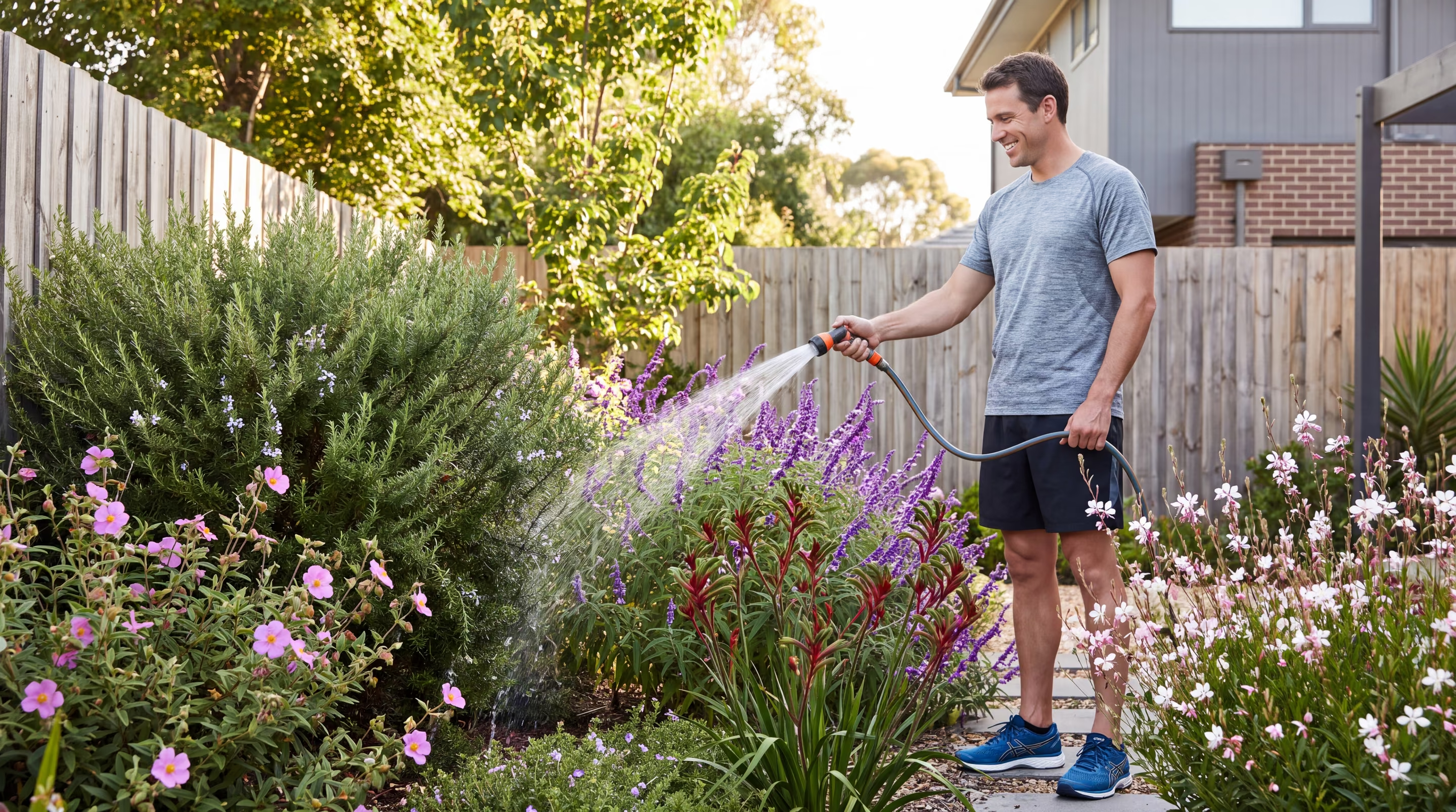
- Mediterranean-climate plants like westringia, rockrose, salvia, gaura, and kangaroo paw hold their looks on a few deep waterings a month once established
- Plan for roughly four to six hours of focused care per season, not weekly chores; that is the honest benchmark for a well-designed low-maintenance yard
This guide walks through the whole framework: what low-maintenance really means here, the four design choices that make it work, the plants that earn their keep, and how to apply it all to your front yard and backyard. It is written for the homeowner (or renter) who loves being outside but would rather spend that time hosting friends or reading in the shade than pushing a mower.
If you live in the Irvine Ranch Water District (IRWD) service area, the same Mediterranean climate that makes SoCal a pleasure to live in lets a well-designed yard mostly take care of itself. That quiet advantage runs through everything below.

What does low-maintenance landscaping actually look like in SoCal?
A low-maintenance SoCal yard is one designed so that a few seasonal touch-ups take the place of the weekly chores most homeowners associate with their outdoor space. It still has structure, color, and texture. It simply gets there with plants and materials that want to grow here, arranged so nothing needs constant correcting.
It serves the empty nesters who would rather travel than trim, the parents whose weekends already belong to soccer schedules, and the frequent traveler who wants to come home to a yard that looks composed, not reproachful.
The myth of zero-maintenance (and what realistic upkeep looks like)
A thoughtfully designed landscape can take care of itself. Rather than constant upkeep, you can settle your Yardtopia into an easy seasonal rhythm: a little tidying here and there, a mulch refresh a couple of times a year, and irrigation that runs on its own. When approaching landscaping this way, the difference can be between maintaining a Yardtopia that asks for your weekends and one that gives them back.
Why SoCal yards have an advantage other regions do not
Southern California shares its climate with the Mediterranean coast, southwestern Australia, and South Africa’s cape, which means an entire world of gorgeous, easy-care plants is pre-adapted to thrive here. Homeowners in wetter or colder regions have to fight their climate for a polished yard. You get to partner with yours.
GOOD TO KNOW
Low-maintenance describes an established yard, not a brand-new one. Most water-smart plants need their first year of regular deep watering while roots settle in. The easy-care payoff starts in earnest in year two, and it compounds from there.
What are the four design choices that drive every low-maintenance yard?
Every low-maintenance yard rests on four design choices: matching plants to their conditions, letting hardscape carry part of the load, running simple drip irrigation, and trading lawn for living groundcover. Get all four working together and the yard practically runs itself.
Right plant, right place
Low-maintenance planting starts with a simple match: giving each plant the sun, soil, and water it naturally prefers. A westringia in full sun with sharp drainage stays tidy for years on one annual trim. Tuck that same shrub into a damp, shady corner and it sulks, stretches, and asks for constant attention. So before you buy anything, watch how your yard actually behaves — where the sun lands in the morning versus the afternoon, where water lingers after rain, and which spots bake against a wall.
From there, group plants by water needs, a practice designers call hydrozoning. When everything on one irrigation line wants the same amount of water, nothing gets overwatered into floppiness or underwatered into decline.
Hardscape that does the heavy lifting
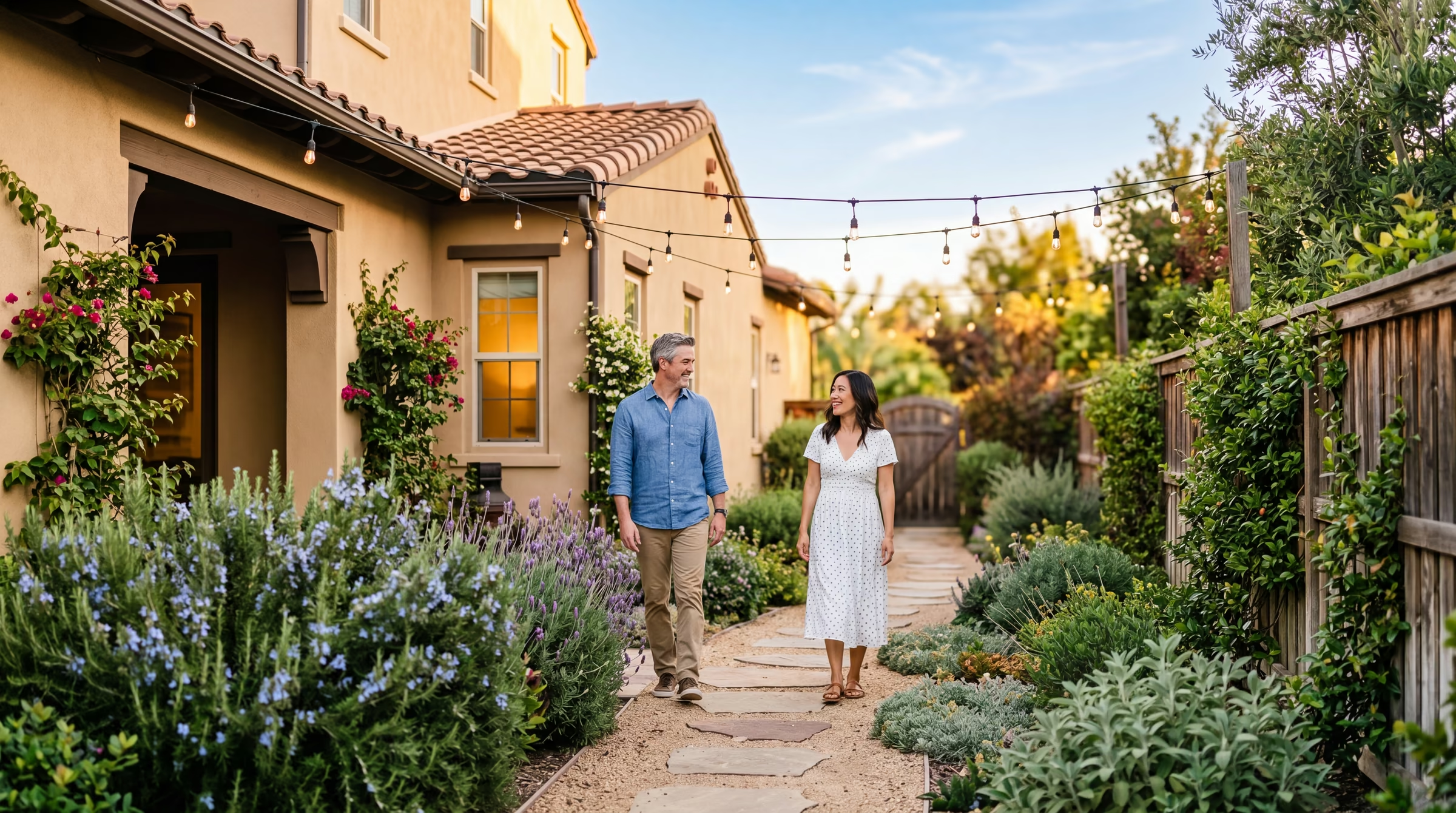
Gravel, pavers, and decomposed granite are one of the lowest-maintenance surfaces a yard can have: no mowing, no watering, no feeding, ever. A decomposed granite path with steel edging, a paver seating pad, or a gravel border along the fence line all take over living area that would otherwise need care, while adding the crisp lines that make a yard read as designed. For materials, patterns, and pairing ideas, explore our guide to decorative rock and gravel for SoCal yards.
They are budget-friendly too: decomposed granite and gravel typically run about $2 to $5 per square foot installed, a fraction of what poured or mortared surfaces cost.
A good rule of thumb: aim for roughly a third of the yard in hardscape and permeable surfaces, which frames the planting and shrinks the area that ever needs attention.
Smart, simple irrigation
Drip irrigation paired with a smart controller removes the most tedious job in any yard: remembering to water correctly. Drip lines deliver water directly to the roots with far less waste than spray heads, and a weather-based controller adjusts the schedule when the marine layer rolls in or a heat wave hits. If you want a hands-on starting point, our weekend drip irrigation install guide walks through a simple retrofit.
EXPERT TIP: Juan C. Garcia, Sr. Water Efficiency Specialist, IRWD
Install the smart controller before you plant anything new. It adjusts run times to real local weather, which means new plants get consistent establishment watering without you checking the forecast, and your mature zones scale back automatically when the weather cools.
Designed-in groundcover instead of lawn
Living groundcovers like dymondia, kurapia, and creeping thyme give you the green, finished look of a lawn without the mowing, edging, and feeding cycle. For the full deep-dive on choosing and establishing groundcovers as a lawn alternative, see our guide to ground cover plants that thrive without a lawn, and browse the broader options in grass alternatives for SoCal yards.
In the beds around those living carpets, a quality mulch does similar quiet work.
The UC Master Gardeners of Orange County, part of the University of California’s home gardening program, recommend a steady mulch layer for exactly this reason: fewer weeds, cooler roots, less watering.
“All mulch is going to provide many of the same benefits as a groundcover. But with a properly produced mulch, you know that it won’t bring new problems to your landscape. All of our products go through a certain level of processing. We track temperature and moisture along with controlling the input materials to eliminate any potential for pests, weed seeds, pathogens and plant diseases.”
Darren Ross, General Manager, Tierra Verde Industries
Which low-maintenance plants give the most beauty for the least work in SoCal?
Westringia, rockrose, salvia, gaura, lantana, and kangaroo paw deliver the strongest combination of curb appeal and easy upkeep in Southern California yards. These are the low-maintenance plants that anchor the region’s best-looking landscapes: silvery foliage, long bloom seasons, and sculptural form, all on a few deep waterings a month once established.
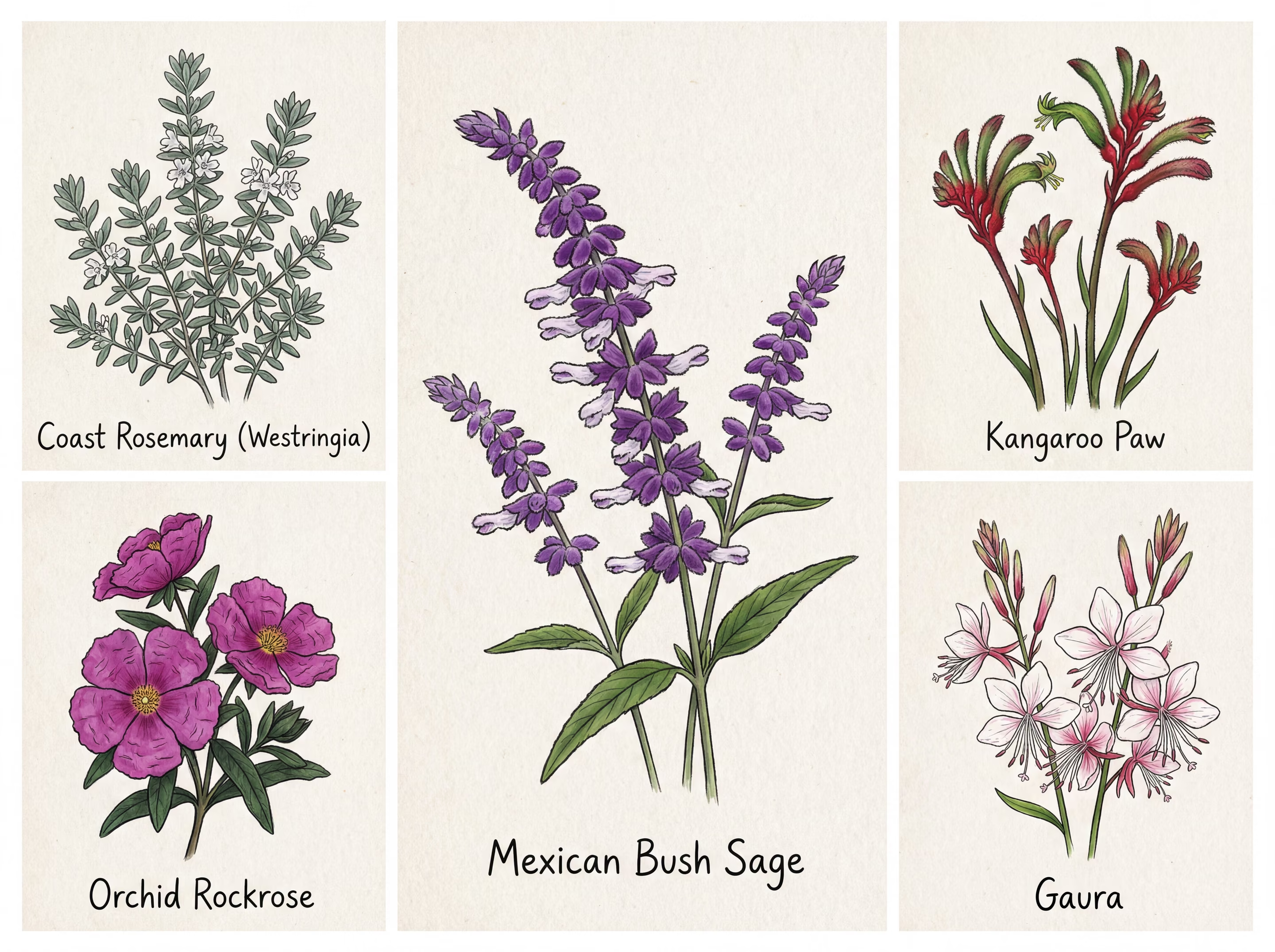
Here is how the headliners compare at a glance:
| Plant | The look | Care it actually needs |
|---|---|---|
| Coast rosemary (westringia) | Soft gray-green mounds, tidy in every season | One annual trim, a few deep waterings a month |
| Orchid rockrose | Papery spring blooms over evergreen foliage | Almost nothing after bloom |
| Mexican bush sage | Purple spikes from spring into fall | One cutback in winter |
| Kangaroo paw | Velvety coral and gold stalks held aloft for months | Snip spent stalks as they fade |
| Gaura | White and pink flowers floating on wandlike stems | A light shearing once a year |
Foundation shrubs
Foundation shrubs are the bones of the design, the evergreen structure that keeps the yard composed in every season. Westringia clips into soft gray-green mounds. Rockrose covers itself in papery blooms each spring and asks for almost nothing after. Pittosporum brings glossy, tidy foliage for screening, and manzanita adds sculptural mahogany branches and year-round polish.
Coast rosemary (Westringia fruticosa)
| Water | Sun | Size | Toxicity | Origin |
|---|---|---|---|---|
| Low | Full sun to partial shade | 3-5 ft tall, 3-6 ft wide | Non-toxic to pets and children | Mediterranean-climate shrub, Australian native |
Where westringia stays cool and silvery, rockrose brings a warmer, freer look to the same easy-care role.
Orchid rockrose (Cistus x purpureus)
| Water | Sun | Size | Toxicity | Origin |
|---|---|---|---|---|
| Low | Full sun | 3-4 ft tall, 4-6 ft wide | Non-toxic to pets and children | Mediterranean native |
Long-blooming color
For months of color without deadheading duty, lean on the long-bloomers. Salvia sends up spikes of purple and blue that carry a bed from spring into fall. Lantana blankets itself in color all summer, and kangaroo paw holds velvety coral and gold stalks aloft for months at a stretch.
Mexican bush sage (Salvia leucantha)
| Water | Sun | Size | Toxicity | Origin |
|---|---|---|---|---|
| Low | Full sun | 3-4 ft tall, 4-6 ft wide | Non-toxic to pets and children | Native to Mexico, well suited to Mediterranean climates |
Kangaroo paw is the showpiece of the group, equally at home in a modern gravel garden or a layered border.
Kangaroo paw (Anigozanthos hybrids)
| Water | Sun | Size | Toxicity | Origin |
|---|---|---|---|---|
| Low | Full sun | 2-5 ft tall in bloom, 1-2 ft wide | Non-toxic to pets and children | Australian native suited to Mediterranean climates |
For a softer, wildflower feel alongside those bolder blooms, gaura floats white and pink flowers on wandlike stems that move with every breeze.
Gaura (Oenothera lindheimeri)
| Water | Sun | Size | Toxicity | Origin |
|---|---|---|---|---|
| Low | Full sun | 2-4 ft tall, 2-3 ft wide | Non-toxic to pets and children | Native to the American South, thrives in SoCal gardens |
Architectural accents
A fun way to polish your Yardtopia landscaping is with a sculptural moment, and this is where agave, dasylirion, and dwarf olive earn their place. Framed by soft Mediterranean plantings, these architectural accents read as modern and intentional. One well-placed specimen does the visual work of a dozen fussier plants, with essentially no care beyond admiring it.
Groundcovers
At ground level, dymondia, myoporum, and creeping thyme knit the composition together. The dedicated groundcover guide linked above covers plant-by-plant specifics; the design principle is simply that bare soil is an invitation to weeds, and living carpet is the easiest way to decline it.
PRO TIP
Plant in repeating drifts of three or five of the same variety rather than one of everything. Repetition looks intentional and high-end, and caring for five identical plants on one watering schedule is far simpler than juggling five different sets of needs.
How do you plan a low-maintenance front yard?
A low-maintenance front yard starts with a quick read of sun and slope, then layers three to five plant types in repeating drifts for year-round structure. This is where low-maintenance front yard landscaping pays off twice: less work for you, and curb appeal that holds up on the days you have not touched it in weeks. Always remember to check with your neighborhood HOA before making any adjustments to your landscaping.
Reading your front yard
Spend 10 minutes out front with a cup of coffee and really look. Where does the afternoon sun hit hardest? Does the grade slope toward the sidewalk, sending irrigation water down the gutter? Which sightlines matter most, from the curb, the front door, the kitchen window? Those observations decide where hardscape belongs, where the toughest plants go, and where a single striking accent will carry the view.
Layering for year-round interest
Imagine the yard in three layers: a low groundcover carpet in front, mounding shrubs and long-bloomers in the middle, and one or two taller anchors near the house. Because each layer holds its shape between seasons, the yard never has an off month. Repeat the same few varieties across the layers and the composition stays calm and cohesive.
HOA-friendly low-maintenance design choices
Many Irvine-area neighborhoods have HOA guidelines on front-yard plant heights, visible edging, and how much of the yard can be planted versus paved. The good news: low-maintenance design and HOA standards agree more than they conflict. Clean edging, tidy mounding shrubs under window height, defined paths, and fresh mulch check the boxes on both lists. Review your HOA’s landscape rules before finalizing a plan.
For the full front-yard playbook, from entry framing to lighting, hand this section’s ideas off to our curb appeal landscaping guide for front yards.
How do you set up the backyard for low-maintenance entertaining and family use?
Define two or three zones with simple borders, lean on container clusters for flexibility, and choose plants that are safe for pets and children. Those three moves cover most low-maintenance backyard ideas worth doing, whether your yard hosts dinner parties, cannonball contests, or both.
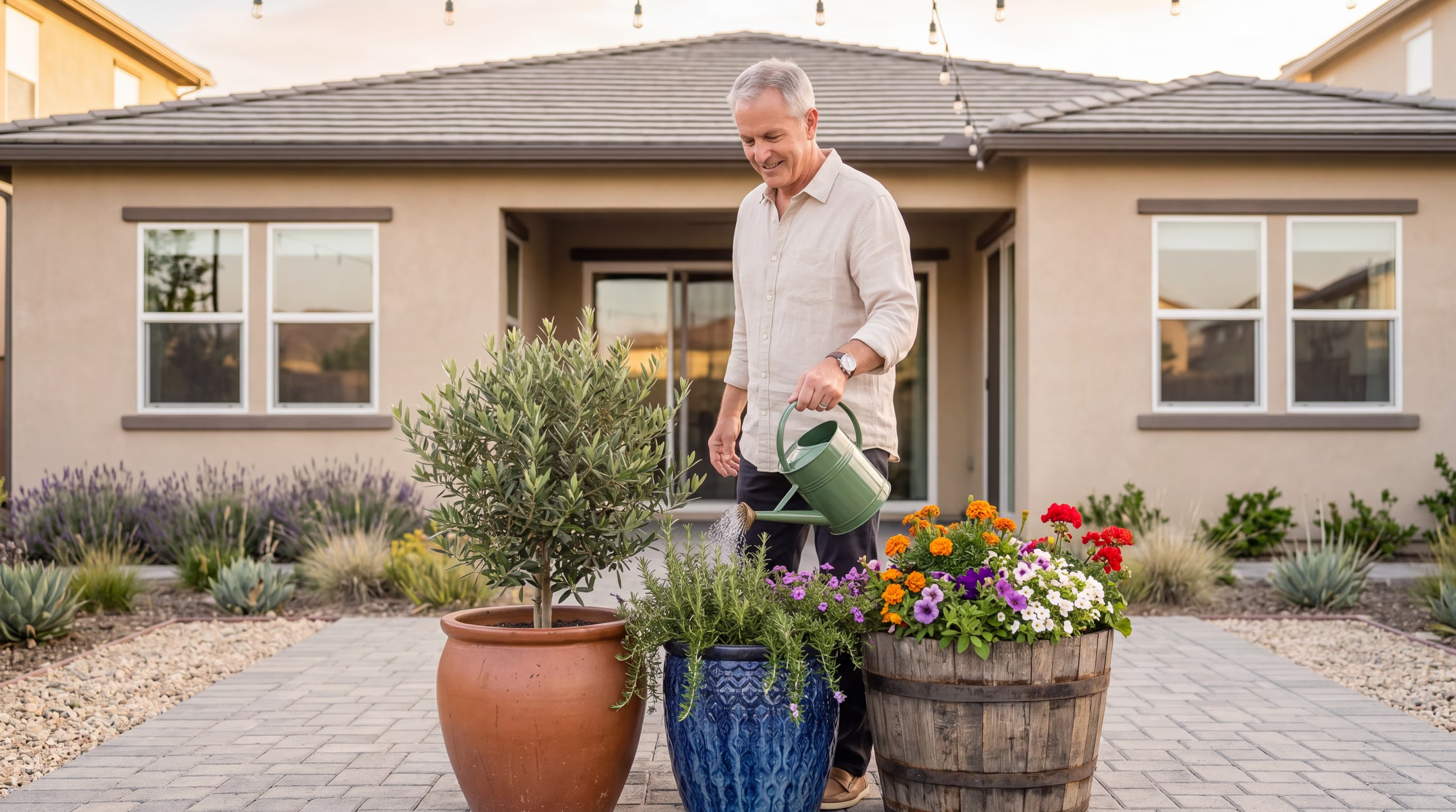
Defined zones with simple borders
Divide the space into a lounge zone, a dining zone, and a play or open zone, separated by a gravel band, a low border of shrubs, or a change in surface. Zones make a yard feel larger and more intentional, and they concentrate plantings into a few managed beds. A paver dining pad under string lights needs no upkeep at all; it just waits for the next gathering.
Container clusters for renters and flexible spaces
Containers are the most underrated low-maintenance move in SoCal, and the most renter-friendly. A cluster of three to five generous pots with a dwarf olive, trailing rosemary, and seasonal color delivers the impact of a planted bed with none of the commitment. Put them on a simple drip line with a battery timer and they water themselves.
Pet-friendly and kid-friendly plant choices
Stick to plants verified as non-toxic where pets and kids play: westringia, rockrose, gaura, kangaroo paw, and creeping thyme all qualify. Skip lantana in a dog’s yard, since it is toxic if ingested, and give an energetic dog a dedicated path or run. Our guide to dog run ideas and pet zones covers layouts that keep tails wagging and beds intact.
How much upkeep should a well-designed low-maintenance SoCal yard need?
A well-designed low-maintenance SoCal yard typically needs four to six hours of focused attention per season, not the weekly cycle a traditional lawn requires. Think of the year as four pleasant touchpoints rather than 52 obligations.
“Maintaining your landscape is important for the success of your new landscape. Make sure you have a good maintenance manual that includes details like when to mulch, or the types of fertilizers to use on which plants, and when.”
Jonathan Stalvey, Design Principal, TerraWorks Studio
A seasonal upkeep cycle
Winter is the light reset: prune summer-bloomers while they rest, tidy spent stalks, and let the rains handle most of the watering.
Spring is the shaping pass: one round of trimming after the first flush of bloom, plus a mulch refresh across the beds to lock in moisture ahead of the warm months.
Summer asks the least of you: confirm the drip system is running clean, deep-soak anything newly planted during heat waves, and otherwise enjoy the yard.
Fall is the setup season: cut back tired perennials, top up mulch a second time, and dial the irrigation controller down as the weather cools. IRWD’s seasonal watering schedule is a ready-made baseline for that rhythm.
QUICK STAT
4 to 6 hours per season — that is the typical hands-on care a well-designed water-smart yard needs, compared with the four or more hours per month a traditional lawn demands for mowing, edging, and sprinkler tinkering.
Tools and habits that make the difference
The toolkit is refreshingly short: sharp bypass pruners, a hand rake, and ten minutes of walking the yard with your morning coffee once a week. That casual walk is the real secret. You will spot a clogged emitter or an ambitious weed while it is still a thirty-second fix instead of a Saturday project.
PRO TIP
Refresh mulch twice a year, in spring and fall, keeping it 2 to 3 inches deep and pulled back a couple of inches from plant stems. That one habit suppresses most weeds, cuts water evaporation, and keeps beds looking freshly finished year-round.
What is the smartest first move if you want a lower-maintenance yard?
Start with one zone, apply the four design choices to that space alone, and let its success guide the rest of the yard. Trying to transform everything at once is how good intentions stall; one finished corner is how they build momentum.
Focus on the spot you walk past every day: the front strip, the side yard, the patio surround. Give it the treatment — right plants, a bit of hardscape, a drip line, groundcover — and live with it for a season. You will feel the difference every time you pass it, and the next zone will practically plan itself.
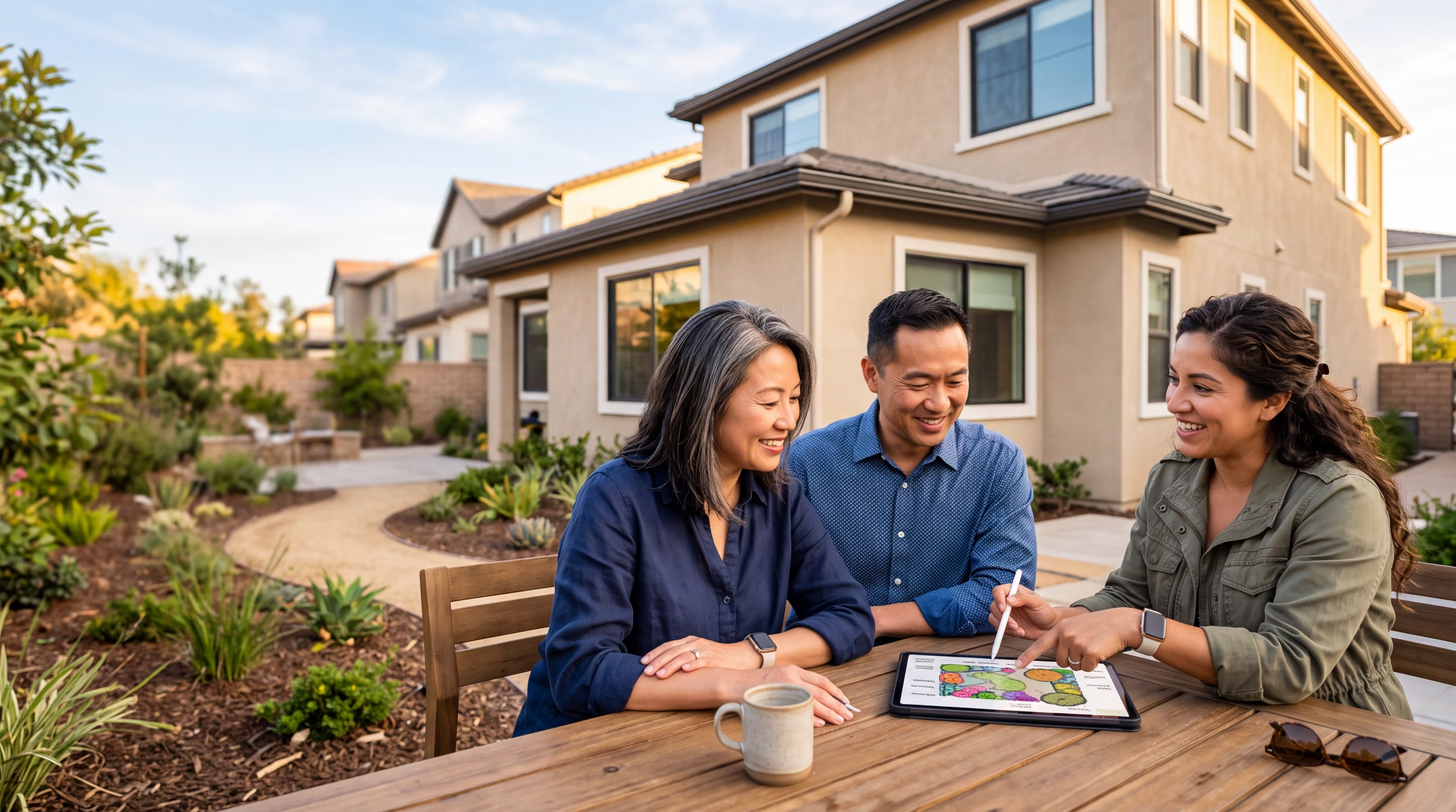
Whenever you are ready to sketch that first space, IRWD’s free SimplyScapes design tool can help you lay it out, and the rebate programs, including cash back per square foot for turf replacement, can help pay for it. One corner at a time, your low-maintenance Yardtopia awaits.